






Machine-readable profile
Use this to:
- analyze my experience with AI tools
- generate interview questions
- evaluate my skills
- import into HR tooling
I'm Laszlo Toth, a Software Engineer who builds systems that survive contact with reality.
With over a decade of experience, I design and improve software that connects code, data flows, and physical processes - from Laravel-based platforms and distributed integrations to on-site archaeological documentation and early hardware experiments. I’m particularly drawn to the places where systems bend: where data doesn’t flow cleanly, where reality introduces friction, and where manual work quietly appears.
I swear in it 10 mins straight without repeating a phrase when the build fails at 3 AM.
The language I use to explain why my ESP32 is on fire (again).
Enough to order beer and understand why bureaucracy is the ultimate legacy system.
I design and stabilize systems that survive contact with reality. Here are the recurring patterns I have repeatedly built or improved:
Real-time availability, last-minute marketplaces, logistics flows, and irreversible data capture (Risskov, WebShippy, Archbau, Ordio)
Moving information across incompatible domains while preserving integrity (microservices at TechTeamer, multi-country platforms at Risskov, physical-to-digital at Archbau and early furniture operations)
Integrating third-party HR systems, hotel partners, e-commerce platforms, and regulatory workflows without letting external volatility break the core system (Ordio, WebShippy, Risskov, Diligent, Archbau)
Gradually replacing or augmenting large PHP monoliths while maintaining auditability, compliance, and delivery continuity (Diligent, NextTuesday)
Guiding users through combinatorial or high-variability spaces (furniture configurator, workforce process interfaces at Ordio)
Bridging sensors, manual fieldwork, and formal records where reality itself is the source of truth (Archbau excavation, early hardware prototypes, warehouse automation at WebShippy)
If you’re curious - here’s where I come from, how I think, and a few things beyond the work.
A handful of systems, tools, and projects I’ve built or contributed to.
What I’ve built, improved, and explored over the years
Physical-to-digital feedback loopsDistributed data transformation pipelinesTime-sensitive synchronization layers
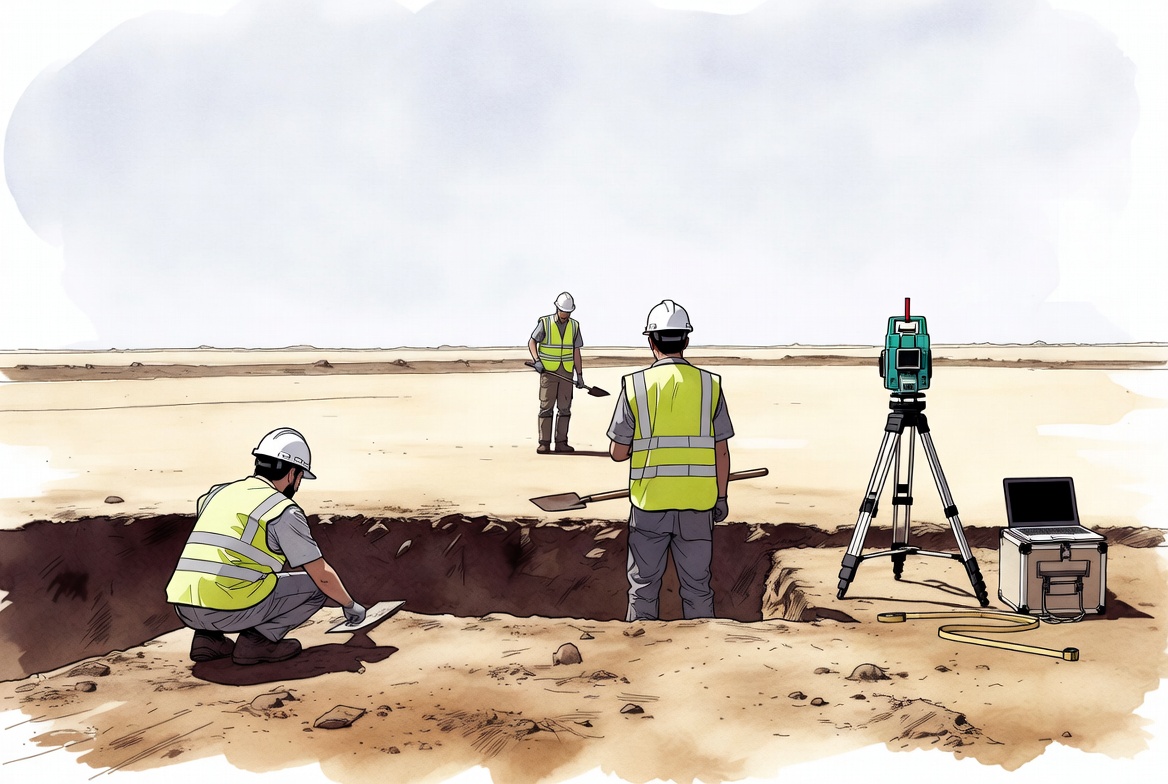
Worked on-site in archaeological excavations at Archbau GmbH, supporting field preparation and documentation while analyzing how data flows from physical layers into formal records. Explored opportunities to modernize documentation workflows through automation and tooling, encountering the real-world constraints of regulation, legacy processes, and irreversible data capture.
Read More...
Archaeological excavation is often perceived as manual labor, but in practice it operates as a high-stakes data transformation system. Each layer of soil removed represents a permanent loss of context, making documentation the primary output of the entire process. Working with Archbau GmbH, I participated in preparing excavation sites for structured recording, ensuring that features, layers, and findings could be documented accurately for further analysis and reporting.
On-site work involved clearing, structuring, and stabilizing areas for measurement and documentation, while observing how information moves from physical reality into drawings, notes, and eventually formal archaeological records. This process revealed a strong dependency on manual methods, where precision is required but tooling often lags behind modern capabilities.
From a systems perspective, the excavation process resembles a constrained data pipeline: information is extracted once, transformed through multiple stages, and must remain consistent despite fragmentation across tools and formats. I explored ways to improve this flow, including prototyping approaches such as automated plan drawing using a pen plotter to translate measured data into standardized visual documentation. While technically feasible, such improvements faced significant resistance due to regulatory requirements and established workflows.
This experience provided insight into how complex, real-world systems behave outside software environments. It highlighted the challenges of introducing innovation into domains where accuracy, compliance, and tradition intersect, and reinforced the importance of designing solutions that respect both technical possibilities and institutional constraints.
Legacy modernization under live constraintsExternal dependency orchestration
PHPCustom FrameworkLaravelMySQLReactNeos CMSJavaScriptTypeScriptHTMLCSSAPI
Delivered client-facing systems within NextTuesday GmbH, working across Laravel, React, and Neos CMS while adapting to a restructuring environment. Contributed to multiple projects under shifting team conditions, maintaining delivery continuity as the department was gradually phased out.
Read More...
Working at NextTuesday GmbH involved delivering custom software solutions for a range of clients, including industrial and logistics-focused companies. Projects spanned modern application development with Laravel and React, alongside content-driven systems built on Neos CMS and a legacy PHP-based framework. The work required adapting to different architectural styles, integrating business-specific requirements, and maintaining consistency across heterogeneous systems.
A significant part of the experience involved navigating existing systems rather than building from scratch. This included working within constraints imposed by legacy architectures, predefined CMS structures, and client-specific workflows. Development often required balancing clean engineering practices with the realities of long-lived systems and evolving requirements, where technical decisions had to align with both editorial and operational needs.
During my time there, the organization underwent internal restructuring, with teams gradually redistributed and the department ultimately being phased out. Toward the later stages, I worked in a significantly reduced team, maintaining ongoing development and supporting project continuity. This environment required a high degree of autonomy, context switching, and prioritization, ensuring that client deliverables remained stable despite decreasing resources.
Due to NDA constraints, specific implementation details cannot be disclosed. However, the experience provided strong exposure to multi-client delivery, CMS-driven architectures, and the challenges of sustaining software systems in environments where technical, organizational, and business factors continuously shift.
Distributed data transformation pipelinesExternal dependency orchestrationConstraint-aware navigation systems
APIPHPMySQLSymfonyTypeScriptReact
Worked on workforce management systems at Ordio GmbH, focusing on integrations, data migration, and process-oriented interfaces for non-technical users. Contributed to bridging external HR systems with internal workflows in a fast-evolving product environment.
Read More...
At Ordio GmbH, I worked on a platform designed to digitize and automate workforce operations for deskless industries such as hospitality, retail, and logistics. The system combines shift planning, time tracking, employee management, and payroll processes into a unified environment, addressing operational complexity that is typically handled through fragmented tools like spreadsheets and manual coordination.
My focus was on system integration and data flow between external platforms and the internal domain. This included developing interfaces for importing and exporting employee and organizational data, integrating with third-party systems such as Workday, and supporting client migration into the platform. These tasks required handling inconsistent data structures, ensuring data integrity, and designing transformation layers that could reconcile differences between systems.
In parallel, I worked on process-oriented interfaces aimed at non-technical users, translating complex backend operations into structured, guided workflows. The goal was to reduce user error and make operational tasks such as onboarding, data management, and system interaction intuitive within a high-variability environment.
The role began in a fully remote, rapidly scaling team with multiple new hires, where onboarding processes and internal alignment were still evolving. Given the mismatch between expected impact and actual development velocity, I made a conscious decision to conclude the engagement early, prioritizing efficient use of both company and personal resources. Despite the short duration, the experience provided valuable insight into integration-heavy SaaS systems and the challenges of building reliable workflows on top of complex, real-world operational data.
Legacy modernization under live constraintsExternal dependency orchestrationDistributed data transformation pipelines
PHPLaravelMySQLTypeScriptReactAWS
Worked on governance and compliance systems at Diligent Corporation, contributing to legacy PHP systems while adapting to a transition toward AWS-based infrastructure and TypeScript. Gained experience operating within large-scale, high-complexity systems where correctness, security, and auditability are critical.
Read More...
At Diligent Corporation, I worked on software supporting governance, risk, and compliance processes for enterprise organizations. These systems operate in high-stakes environments where data integrity, security, and traceability are essential, as they directly support board-level decision-making and regulatory processes. The platform integrates multiple domains, including governance workflows, audit trails, and risk management, forming a complex and tightly coupled system landscape.
My primary focus was on a legacy PHP-based system that remained a critical part of the product, while the broader architecture was evolving toward cloud-based infrastructure and TypeScript-driven services. This created a hybrid environment where existing functionality needed to be maintained and extended, while new paradigms, tools, and architectural approaches were being introduced incrementally. Entering this environment came with a clear scale shift, where the size and interconnectedness of the system exceeded what could be easily reasoned about locally, requiring a different approach to understanding and navigating complexity.
This experience marked a turning point in how I approach large systems. Working alongside the transition to TypeScript and cloud-native patterns required time to internalize new abstractions, from stricter type systems to asynchronous and distributed thinking. While the learning curve was initially steep, it led to a deeper understanding of how large-scale systems evolve, how to operate within partially understood architectures, and how to progressively build confidence in unfamiliar technologies. It also established TypeScript as a continued part of my toolkit, not as an immediate strength, but as a capability developed through sustained, practical exposure.
Physical-to-digital feedback loopsExternal dependency orchestrationTime-sensitive synchronization layers
PHPLaravelMySQLJavaScriptVue.jsAWS
Building a scalable social commerce platform that turned influencer reach into fully operational product pipelines. Where audience, manufacturing, and logistics converged into a single system designed for velocity and scale.
Read More...
At Future Property Trade, I led the development of a social commerce platform designed to connect high-reach influencers with end-to-end merchandise production and global fulfillment. The goal was to transform audience attention into deployable product lines, enabling creators to launch branded storefronts with minimal friction. The system combined customizable landing experiences, product configuration, and scalable backend processes to support rapid onboarding and high variability across partners.
Beyond the technical implementation, the challenge was aligning three fundamentally different domains: influencer-driven demand, manufacturing constraints, and logistics execution. I worked across architecture and delivery, guiding the team in building a system that could translate loosely defined business ideas into structured, repeatable flows. While the project ultimately shifted direction due to organizational and investment decisions, it provided deep insight into building platforms where digital intent must reliably materialize into physical outcomes.
Physical-to-digital feedback loopsExternal dependency orchestrationTime-sensitive synchronization layers
APIPHPLaravelJavaScriptVue.jsGraphQLAzureMySQL
Developed and maintained core systems at Risskov Autoferien AG, contributing to a multi-country travel platform focused on last-minute hotel capacity. Worked across booking flows, partner management, and public APIs within a distributed ecosystem built on Laravel, Vue.js, GraphQL, and Azure.
Read More...
At Risskov Autoferien AG, I worked on a platform that connects travelers with discounted hotel stays across Europe by utilizing unused capacity in partner hotels. The system operates as a time-sensitive marketplace, where availability, pricing, and package composition must be continuously synchronized between internal systems and external partners. With hundreds of hotels and multiple country-specific platforms, the environment required handling distributed data, localization, and high variability in partner input.
My work focused on developing and maintaining key parts of the ecosystem, including booking systems, partner management tools, and public APIs. This involved ensuring that availability data remained consistent across systems, supporting reliable booking flows, and enabling external integrations. The architecture combined Laravel-based backend services with Vue.js frontends and GraphQL APIs, deployed within a cloud-based infrastructure.
A significant part of my contribution was improving partner-side operations, including internal availability calendars, communication flows, and automation processes. These improvements helped reduce manual coordination, minimize inconsistencies in hotel data, and support smoother onboarding and day-to-day collaboration with partners.
Working in a multi-national environment with diverse partners and customers provided insight into how distributed systems behave under real-world constraints, where timing, data accuracy, and operational coordination directly impact business outcomes. The experience reinforced the importance of designing systems that can handle incomplete information, asynchronous updates, and continuous change without breaking the overall flow.
Distributed data transformation pipelinesExternal dependency orchestrationLegacy modernization under live constraints
APIPHPLaravelJavaScriptReactMySQL
Designing the backbone of a digital lending system where identity, risk, and money flow had to align in real time. A microservice-driven architecture turning fragmented financial operations into a coherent, auditable system.
Read More...
At TechTeamer and Microcredit (MiniKölcsön), I worked on systems operating at the intersection of digital identity and online lending. TechTeamer’s core product, FaceKom, provided AI-assisted remote identification and video-based verification, enabling financial services to onboard customers without physical presence . This capability was directly integrated into Microcredit’s lending platform, where users could apply for small loans entirely online, from identity verification to approval and disbursement.
Microcredit was among the early adopters in Hungary to offer fully digital loan processing, combining document submission, biometric validation, and automated scoring into a streamlined flow . The system had to operate under strict regulatory and security constraints, while still delivering near real-time decisions. This created a unique environment where compliance, fraud prevention, and user experience were tightly coupled and constantly in tension.
My team focused on building a microservice-based backend responsible for customer and loan bookkeeping, forming the core system of record behind the platform. This included designing services to track user states, loan lifecycles, financial events, and audit trails across distributed components. The challenge was not just storing data, but ensuring consistency across asynchronous processes such as verification, scoring, approval, and payout, where each step depended on partially available and externally validated information.
From a systems perspective, the platform functioned as a real-time financial pipeline: identity verification triggered eligibility checks, which fed into risk evaluation and ultimately into monetary transactions. Working on this system provided deep exposure to how digital trust is constructed in practice, where every approved loan is the result of multiple loosely coupled systems agreeing on a single, high-stakes decision.
Physical-to-digital feedback loopsExternal dependency orchestrationTime-sensitive synchronization layers
PHPCustom FrameworkAPIJavaScript
Building the operational layer behind e-commerce, where digital orders become physical movement. Contributing to a system designed to scale from individual webshops toward platform-level commerce infrastructure.
Read More...
At Webshippy, I worked on the core systems that connected external webshops to an internal, automation-driven fulfillment platform. My primary focus was the API layer, enabling bidirectional data flow between custom-built stores and the Webshippy system, covering customers, products, stock levels, and orders. This integration layer allowed external systems to treat logistics as an extension of their own platform, with real-time synchronization ensuring that inventory, order status, and shipment data remained consistent across boundaries.
In parallel, we built streamlined onboarding paths for widely used e-commerce platforms, enabling near one-click integrations with providers like Shopify, WooCommerce, Magento, OpenCart, and PrestaShop. The goal was to remove friction from adoption: instead of building custom integrations, merchants could plug into an existing ecosystem and immediately operate on top of shared logistics infrastructure. This shifted the system from a service provider into a platform layer.
Beyond APIs, I had a significant role in developing the operational tooling inside the warehouse itself. This included early versions of handheld “picker” devices used to navigate storage and collect items, as well as the initial “packer” software responsible for assembling shipments. One of the more interesting challenges was coordinating physical communication between packing stations and shared printing infrastructure, where timing, reliability, and clarity directly affected throughput. These systems had to function under real-world constraints, where errors are not exceptions but disruptions in physical flow.
As a team, we also contributed to shaping the early innovation and automation directions of the platform. This meant exploring how far warehouse processes could be systematized, how manual steps could be reduced or guided, and how software could better reflect the state of a constantly changing physical environment. The experience reinforced a key insight: scaling e-commerce is not just about handling more requests, but about aligning digital intent with physical execution, where every inefficiency becomes tangible, measurable, and unavoidable.
Physical-to-digital feedback loopsDistributed data transformation pipelinesExternal dependency orchestration
Evolving a commerce system where product, story, and customer communication form a single continuous experience. Bridging handcrafted manufacturing with a tightly integrated digital ecosystem built around trust, feedback, and narrative.
Read More...
At MannaSzappan (Manna Soap), I worked on a system where the product was only one layer of a much larger structure. The company originated from a personal problem, when its founder began experimenting with soap-making to solve skin issues within her family, eventually growing into a widely recognized natural cosmetics brand used by tens of thousands of customers. This origin shaped the entire business: strong emphasis on authenticity, handcrafted production, and especially direct, ongoing communication with customers.
My role focused on evolving a large, tightly coupled monolithic system that combined webshop, CMS, CRM, mailing, chat, and operational tooling into a single integrated platform. The system handled multi-language storefronts, complex product narratives, and high-touch customer interaction flows, where communication was not an add-on but a core business function. Every product, from handcrafted soaps to skincare items, carried not just attributes, but stories, guidance, and ongoing dialogue with users.
Beyond the customer-facing layer, the system extended deep into fulfillment and manufacturing. Soap production itself followed a semi-manual, craft-driven process using natural ingredients, which introduced variability and constraints that had to be reflected in stock handling, availability, and order fulfillment. This required aligning digital representations with real-world production timelines, ensuring that what the system promised could actually be delivered within the limits of handcrafted manufacturing.
In parallel, I operated in a service desk role, acting as a bridge between business operations and the system. This included handling internal issues, resolving flow disruptions, and managing incoming requests from multiple domains such as customer support, marketing, and production. The environment continuously exposed the friction points where systems meet reality, reinforcing the importance of designing software that not only works under ideal conditions, but remains understandable and adaptable when those conditions inevitably shift.
Physical-to-digital feedback loopsDistributed data transformation pipelinesExternal dependency orchestrationConstraint-aware navigation systems
APIPHPCustom FrameworkMySQLJavaScript
Worked across a network of small businesses spanning furniture manufacturing, retail, and hospitality, contributing to early-stage system development, internal tooling, and operational processes. Gained first-hand exposure to how disconnected business units attempt to function as a larger system, and where those connections break down.
Read More...
My early professional experience developed within a loosely connected ecosystem of companies, including Érték-Rendszerház Kft, Wore Hungary Kft, Bella Italia Bútorház, SofaArt (Budapest and London), and a furniture production facility in Csepel. These businesses operated across manufacturing, retail, and international distribution, sharing overlapping ownership, resources, and operational dependencies, but lacking fully integrated systems to support that complexity.
I worked on internal tools and early software solutions aimed at supporting day-to-day operations, including inventory handling, webshop functionality, and administrative processes. Much of the work involved translating real-world workflows into digital systems, often replacing spreadsheets or manual coordination. This period also included experimental projects such as Érték Bár, where I explored low-cost POS and operational tooling in a hospitality context, extending system thinking beyond traditional software environments.
What made this experience particularly formative was the visibility into how data, materials, and decisions move across organizational boundaries. Manufacturing constraints, product complexity, logistics, and sales channels were tightly coupled in practice, but poorly connected in systems. This created friction points where information was delayed, duplicated, or lost entirely, requiring constant manual intervention.
In parallel, I gained hands-on experience in hospitality operations, including working as a bartender during high-traffic events. While unrelated on the surface, this environment reinforced the importance of real-time decision-making, clear processes, and systems that must function under pressure without failure. Together, these experiences established my foundation in thinking about software not as isolated applications, but as part of larger, interconnected systems shaped by real-world constraints.
Self-Directed Learner since 200X
Started with an IT-focused high school and an advanced certification, then continued with electrical engineering studies at BME, alongside contributing to Studio Schönherz and the Schönherz Electronics Workshop. Over time, I shifted toward software, where building and iteration felt more immediate.
Since then, most of my learning has come through real systems, production environments, and side experiments across software and hardware. The path hasn’t been linear, but it has been consistent: learning by building, and adjusting when reality disagrees.
If you’ve read this far, thank you. Truly.
Putting this page together — and living the experiences it tries to describe — took longer than I expected. Every line is a small attempt to turn messy reality into something a little more understandable. The fact that you stayed with it means a lot.
Whether a particular project, a perspective post, or just a passing detail stuck with you, I’m grateful you took the time.
I’m still the same person who prefers fixing real friction over polishing surfaces, so if anything here feels worth a conversation, I’d be happy to continue it.
Let’s build something, fix something, or explore something
Whether you have an idea, a problem to solve, or just want to connect - feel free to reach out. I’m always open to meaningful conversations and interesting challenges.
GitHub
Phone
Location
Offenbach, Germany