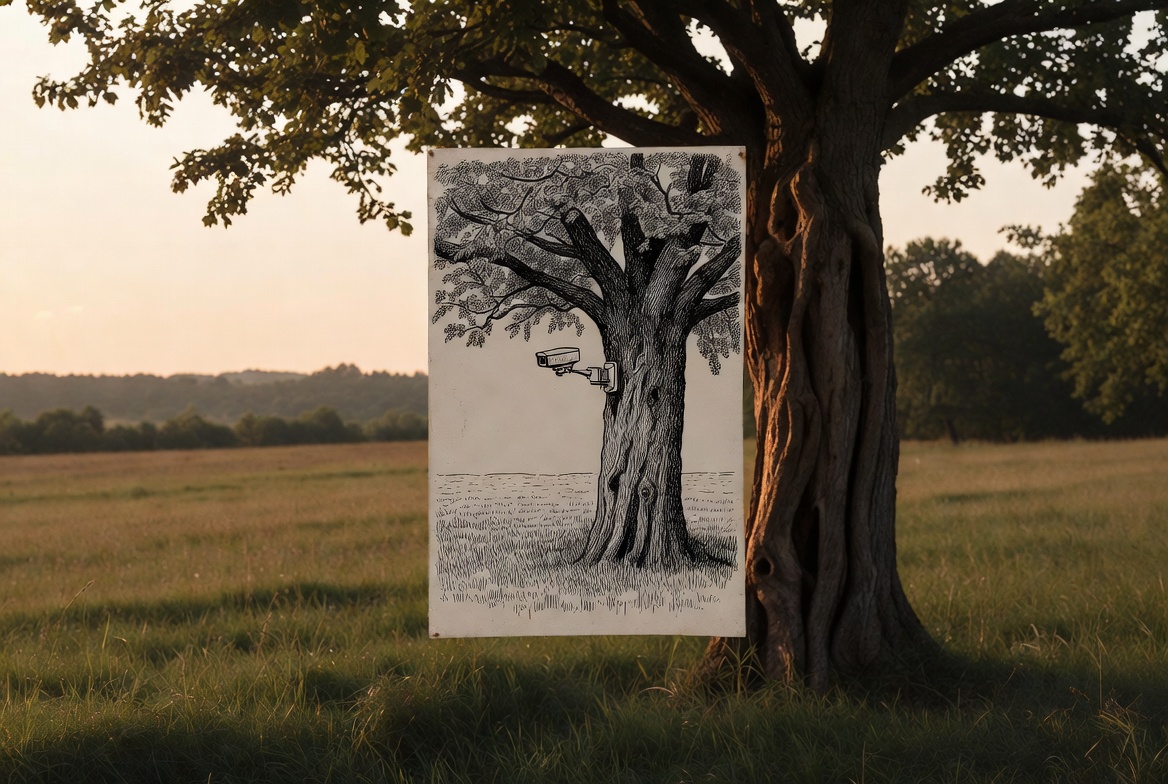
1. Current Status: Pre-Deployment, Waiting for Reality
WildNode is currently in its most honest phase:
designed, reasoned about, partially assembled… but not yet exposed to the environment it is meant to survive.
Core architecture decisions are in place:
- ESP32-CAM as the central node
- Solar + Li-ion power system (CN3791 + BMS)
- SD-based local storage
- Offline-first operation model
What’s missing is not code.
It’s contact with reality.
The next step is physical wiring, enclosure design, and first field deployment.
This is where assumptions about power, stability, and behavior will either hold or collapse.
2. System Concept: A Persistent, Low-Energy Observer
WildNode is designed as a small, autonomous environmental observation unit.
Not a high-frequency sensor.
Not a real-time system.
But a persistent presence.
Its operational loop is intentionally minimal:
wake → capture → measure → store → attempt upload → sleep
This cycle defines its identity:
- bounded energy usage
- predictable behavior
- independence from infrastructure
The system is built to function:
- in forest edges
- along agricultural boundaries
- near roadside ecosystems
- within restoration or rewilding areas
Environments where:
- change is slow
- observation is rare
- and context is easily lost
3. Cinematic Telemetry: Making Change Visible
WildNode is not only a sensing device.
It is an attempt to turn environmental data into something perceivable.
Cinematic Telemetry
The core idea is simple:
- images provide continuity
- sensor data provides context
- time provides meaning
Individually, each is limited.
Together, they begin to reveal patterns.
Examples of what emerges:
- vegetation growth aligned with humidity and temperature
- subtle human impact over time (paths forming, disturbances)
- seasonal transitions compressed into visible sequences
This is not real-time monitoring.
It is slow observation.
The goal is not to react instantly, but to:
- notice gradual shifts
- preserve context
- and surface changes that would otherwise normalize
4. Narrative Layer: The Node as Observer
WildNode can also be understood as a narrative construct.
Not interactive.
Not adaptive in a human sense.
But continuously present.
Recording.
This allows the system to act as a perspective, not just a device.
Narrative Possibilities
The same data can be framed in different ways:
Observational
- neutral documentation of change
- minimal interpretation
- long, uninterrupted sequences
Analytical
- overlays of sensor data
- highlighting correlations and anomalies
- structured interpretation of patterns
Critical
- exposing environmental degradation
- showing human impact over time
- making invisible processes visible
Reflective
- focusing on perception, memory, and normalization
- what changes without being noticed
- what disappears without being recorded
The Node as Narrator
An optional layer is to treat the node itself as a continuous witness.
Not as a character, but as a stable point of view.
- always present
- always recording
- never reacting
This framing allows content that feels less like reporting and more like observing through something.
5. Content Strategy: From Data to Output
WildNode is designed to produce not just data, but usable outputs.
Short-Form Content
- compressed time-lapses
- single-location snapshots
- platform-friendly formats
Focus:
- immediacy
- visual clarity
- quick pattern recognition
Long-Form Content
- multi-day or seasonal sequences
- combined visual + telemetry narratives
- slower pacing
Focus:
- accumulation
- context
- deeper interpretation
Hybrid Outputs
- time-lapse + sensor overlays
- annotated environmental shifts
- comparative sequences across locations
Application Contexts
Without being explicitly tied to them, these outputs align naturally with:
- rewilding and restoration initiatives
- conservation monitoring
- environmental education
- low-impact research projects
In these contexts, the value is not just measurement, but:
- visibility
- communication
- and continuity over time
6. Future Capabilities: From Node to System
WildNode becomes more interesting when it stops being a single device.
Distributed Nodes
Multiple nodes create:
- spatial context
- comparative observation
- redundancy
Instead of one timeline, you get a network of perspectives.
Communication Models
LoRa Mesh + Gateway
Nodes can form a low-bandwidth mesh network:
- transmitting summaries or key data points
- relaying through intermediate nodes
- eventually reaching a gateway connected to the internet
This allows:
- minimal infrastructure
- long-range communication
- energy-efficient synchronization
Data Mule Approach
In environments without connectivity, data can be collected physically.
A “data mule” can be:
- a handheld device used during scheduled maintenance
- a unit carried by rangers or field workers
- a mobile receiver that syncs data when in proximity
This model:
- removes dependency on continuous connectivity
- aligns with existing field routines
- keeps the system simple and robust
Autonomous Collection (Experimental)
A lightweight autonomous RC plane could act as a mobile collector:
- flies predefined routes
- connects to nodes briefly
- retrieves stored data
This extends the system into:
- hard-to-reach areas
- large-scale deployments
- low-infrastructure environments
Sensor Evolution
Future iterations may include:
- PIR sensors for motion detection
- event-triggered captures (instead of purely periodic)
- adaptive sampling based on activity
This shifts the system from:
passive observer → context-aware observer
Scalability
The system scales along three dimensions:
- Nodes → more locations
- Time → longer observation periods
- Resolution → richer sensing and context
The challenge is not just adding more nodes, but:
- keeping them maintainable
- keeping behavior predictable
- and keeping outputs meaningful
Use Case Scenarios
WildNode can operate in:
- rewilding zones tracking vegetation recovery
- farmland edges observing biodiversity changes
- roadside environments capturing human impact
- remote natural areas where infrastructure is limited
In each case, the system provides:
- continuous presence
- low-cost deployment
- and a way to see slow change
Closing
WildNode is not trying to compete with high-end monitoring systems.
It operates in a different space:
- low-power
- low-maintenance
- long-duration observation
Its value comes from persistence.
From staying in place long enough
for change to become visible.
And from turning that change into something
that can be understood, not just recorded.